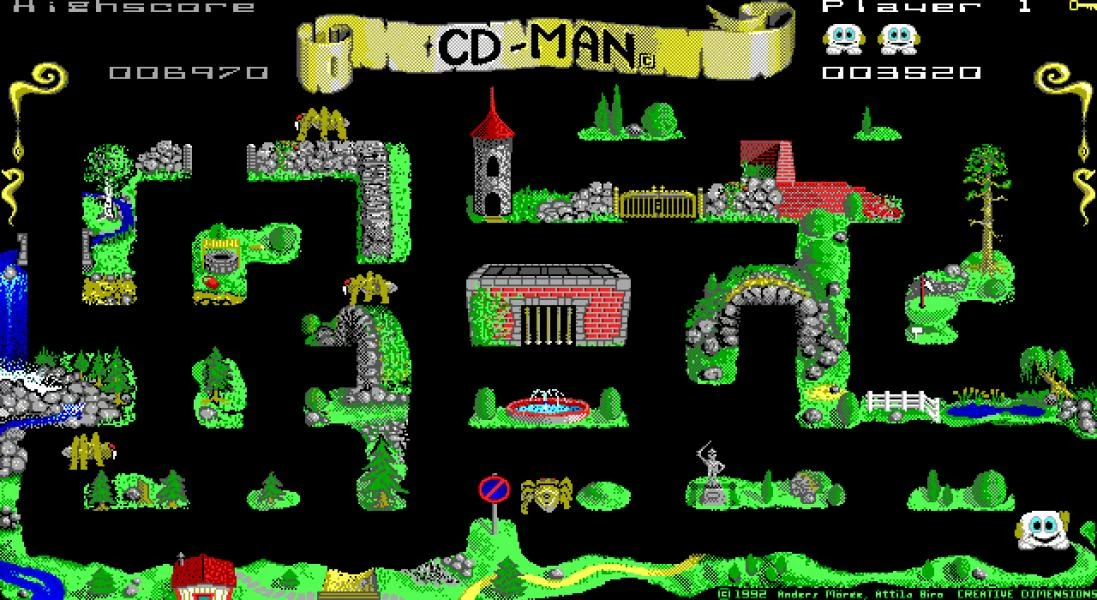
CD-Man arrived in 1989 for MS-DOS, right when home computing was buzzing about a new kind of storage. The very name feels like a wink at that era: a plain-spoken hero tied to shiny, futuristic media, turning the everyday dream of bigger libraries and faster access into a playful premise. While many contemporaries chased brute sci-fi seriousness, this title leaned into novelty and cartoons-with-a-wiring-harness personality, giving players a reason to keep poking at menus and pressing keys just to see what else the world would deliver.
In play, CD-Man focuses on agile traversal and brisk decision-making. The action unfolds in stages that ask you to move with intention, bouncing over obstacles, slipping past traps, and learning where the level designers hid danger in plain sight. Encounters typically blend enemy pressure with navigation puzzles, so progress depends on both reflex and observation. Scattered objectives often reward exploration, nudging you to clear rooms thoroughly rather than sprinting straight to the exit. When things go wrong, the failure state tends to push you toward better routes, not merely more patience.
The presentation matches the late 80s DOS rhythm. Sprites are bold, animations are snappy enough to read clearly during frantic movement, and stage backgrounds give just enough visual separation to prevent the screen from becoming an indistinct blur. Audio, meanwhile, tends to rely on the strengths of PC hardware of the day: bright chiptunes, quick rhythmic cues for danger, and voice-like effects where the sound system permits. Controls are typically straightforward on a standard keyboard, with a compact set of keys handling movement and interaction, which helps the game stay readable even when you are making split-second jumps.
Technically, CD-Man feels like a product of its hardware moment. Expect performance that varies with machine speed and graphics mode, with smoother runs on faster setups and more visible frame hiccups on older systems. On period-correct monitors it can look surprisingly lively, yet the experience remains rooted in the DOS philosophy of immediacy: quick load times, direct input, and minimal ceremony between challenges. Save and continue behavior, as with many releases of the time, can influence how you treat setbacks, encouraging a careful, measured approach once you understand the layout.
The game survives less as a mainstream classic and more as a nostalgic curio for retro communities. Its appeal comes from that particular mix of tech-era whimsy and platforming fundamentals, the kind of design that makes people talk about it long after they have forgotten bigger-budget releases. If you play CD-Man now, it is worth approaching it as a time capsule: a quirky experiment in DOS storytelling that still rewards curiosity, steady hands, and the simple satisfaction of mastering one more tricky corner of a pixelated world.
Download game
It is possible that we have multiple downloads available
when different versions exist.