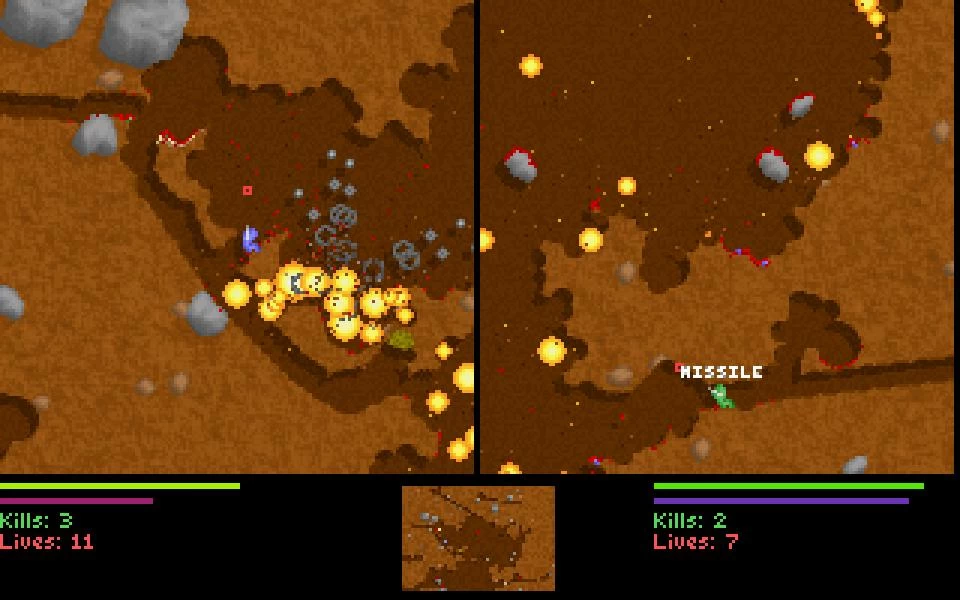
Liero arrived at the tail end of the DOS era as a feverish duel in an arena, released in 1999. Its premise is simple yet savage: worm like fighters hurtle across a top-down stage, weapons blazing in a real-time skirmish. The pace is blistering, the action relentless, and the timing demands almost musical reflexes. Built around twin stick logic on keyboards, the game rewards precision rather than brute luck. It ignores ceremony and leans into pure skill, letting players dance between shots, detonations, and sudden retreats. Fans recall the moment rocket arcs into the corner and a rival collapses in a spray of pixels.
Beating rivals in Liero means juggling movement, aim, and a toolkit that reads like a treasure chest of hardware, often chaotic. You can slip into narrow corridors, cling to ledges, or zip across open space using a dash that doubles as a shield against stray fire. The inventory of weapons is mercilessly varied, from scattershot improvisations to precise rifles, each with distinct arcs and splash damage. Power ups appear as rare accents, nudging a contest from routine to theatre. The sound design crackles with bite; every explosion, every ricochet, carries a satisfying snap that makes competitive sessions feel tactile and thrilling.
Liero also thrives on community invention. Map editors sprout communities with new arenas shaped by quirky themes and clever geometry. Local networks become laboratories for highly competitive matches, while bots extend the field when human players are scarce. The game's balance hinges on a delicate calculus of weapon power, speed, and range, a matrix that can tilt on a single clever maneuver. Players share replays, confirm clever takedowns, and swap tips for surviving the most brutal exchanges. The community keeps the flame alive with occasional ports, patches, and spirited junkyard debates about tactics.
Liero embodies a transitional moment when fast multiplayer gameplay barely fit onto compact personal computers. It demonstrated that intense rivalry could unfold without glossy cinematics, relying instead on deft control and clever code. It traveled through the veil of DOS into Windows worlds and even inspired recreations that keep the core feel intact. For collectors, the title remains a true touchstone of late 90s PC culture, a reminder that friendship and sharp wits could spark off each other in a single afternoon. Its legacy survives in videos, mods, and the stubbornly loyal fans who still chase the next perfect duel.
Download game
It is possible that we have multiple downloads available
when different versions exist.