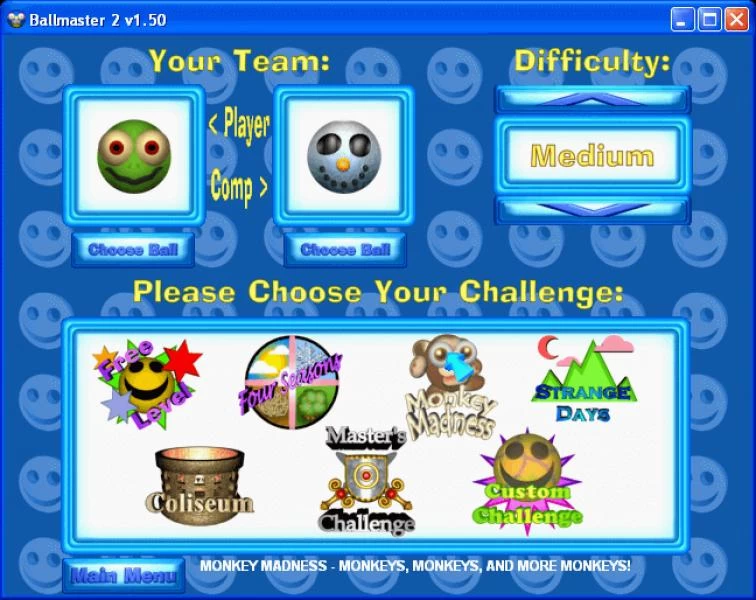
BallMaster 2 is a Windows arcade puzzle game that arrived in 2002 and quickly leaned into the kind of fast-thinking fun that comes from physics and angles. Instead of long cinematics or intricate lore, it focuses on the satisfying loop of launching a ball, reading the board, and recalculating your next move when the world reacts. The presentation feels lightweight and playful, yet the challenges steadily sharpen, rewarding players who can predict bounces, account for friction, and exploit tight geometry.
At its core, the gameplay revolves around clearing objectives across compact arenas filled with bumpers, barriers, and hazards. You typically guide a ball toward targets that can include switches, sockets, or goal zones, where placement matters as much as raw speed. Because impacts alter the trajectory in subtle ways, even experienced players feel the urge to test angles twice, especially when obstacles encourage chain reactions. Timing also plays a role: hold, release, or angle adjustments can change whether a ricochet lands you in safety or ricochets into failure.
Progression is structured as a sequence of levels that gradually introduce new complications. Early boards are about learning the rules of motion, while later stages add moving parts, limited routes, and situations where one careless hit wastes a run. Scoring tends to reward clean clears, efficient paths, and fewer mistakes, so the game subtly nudges you to treat each attempt like a micro-strategy exercise rather than a brute-force scramble. The challenge is friendly at first, then becomes oddly addictive as you chase better outcomes.
What makes BallMaster 2 stand out for many players is how quickly it communicates cause and effect. When a ball clips a corner, you notice immediately; when momentum carries too far, the consequence feels fair rather than random. That clarity helps the learning curve, making retrying feel productive. The sound design supports this by making impacts and successes distinct, which keeps attention locked even during frantic sequences.
By the early 2000s, many PC titles offered polished graphics, but this one aimed for tactile satisfaction. Its charm lies in the brisk rhythm, the brainy spatial planning, and the confidence that every attempt teaches something. For fans of physics-based puzzles and short-session action, it still reads like a compact classic: approachable on the surface, deeper on repeat play, and memorable for the way it turns a simple ball launch into a surprisingly elegant problem-solving ritual.
Download game
It is possible that we have multiple downloads available
when different versions exist.