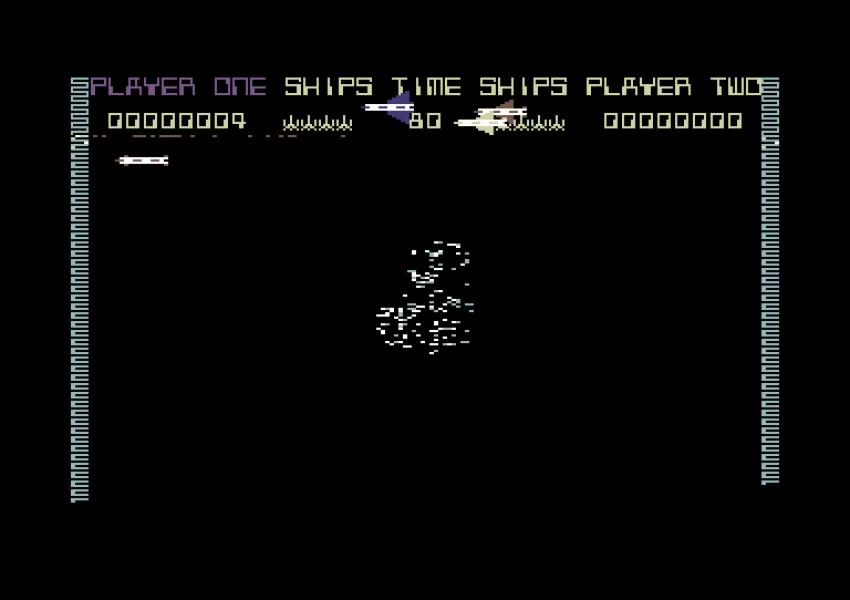
Arcadia is a video game in the action genre developed by Imagine Software Ltd. and published by Imagine Software Ltd. originally released in 1983. It is currently playable on Commodore 64, Dragon 32/64, VIC-20.
Arcadia arrived on the Commodore 64 in 1983, during the era when home computers were still learning how to feel like consoles. The title is often described as a burst of imagination wrapped in a very strict hardware envelope: limited color choices, chunky sprites, and memory that demanded efficient design decisions. Even without flashy cinematic flourishes, it aims for immediacy, putting the player into a shifting challenge loop right away rather than asking for patience. That directness is part of its charm, the sense that the game wants to pull you forward.
In play, Arcadia centers on navigation and quick reactions. The world is presented in a way that rewards scanning, with hazards and objectives arranged so that attention matters as much as speed. Journeys tend to be broken into short segments, meaning you constantly re-evaluate where you are, what you have collected, and what route makes sense next. Success typically comes from learning patterns and exploiting small openings, a style common to early action-adventure experiments on the platform. If you rush without reading the layout, the game punishes that impulse.
Visually, the design leans on high-contrast sprite work and readable tile composition. The background never tries to do everything at once; instead, it offers clean separation between movement space and danger zones. You can feel the constraints in the simplified forms, but the art still manages to look lively through careful animation timing and a consistent palette. Subtle motion cues help you track threats, while the level structure nudges you to keep moving even when you would rather stop and think.
Sound also plays an important role in maintaining tension. The machine’s SID chip can turn simple tones into a convincing atmosphere, and Arcadia uses that strength for feedback, not just background music. Expect audible cues tied to risk, progress, and moments of contact, helping you react even if your eyes are busy. When the action spikes, the audio supports it with sharper rhythms rather than drowning everything in melody.
Arcadia is remembered less for mainstream fame than for the way it captures the early 64-bit imagination in miniature: ambitious intention paired with practical limitations. Its durability comes from that learning curve that feels earned, where skill is developed through repetition and observation. For anyone exploring the 1983 catalog, it offers a useful snapshot of how creators tried to stretch an 8-bit system toward something closer to adventure than arcade one-shots.
Download game
It is possible that we have multiple downloads available
when different versions exist.